
The Okeechobee County Inmate Population
The Okeechobee County inmate population is held across two kinds of facilities. The first is the Okeechobee County Jail, a 344-bed local jail run by the Okeechobee County Sheriff's Office in the City of Okeechobee. It holds people who were just arrested, people waiting for first appearance, people held before trial because bond has not been set or posted, and people serving short county sentences. The second is Okeechobee Correctional Institution, a Florida Department of Corrections state prison north of town that holds men already sentenced to state custody. Both numbers are public, but they come from different agencies and answer different questions.
What moves the count is steady and ordinary. Arrests by the sheriff and city police push people into the jail. First appearance, bond decisions, and dismissals move people out. A felony conviction and a state sentence pull a person out of the county jail and into the Florida prison count, where a separate locator takes over. Because of that, a single name can show up in one system this week and a different one next month, which is why the search path matters as much as the search itself.
Okeechobee County Inmate Population Statistics
The firmest published numbers describe capacity, not a daily headcount. The Okeechobee County Sheriff's Office corrections page lists a 344-bed jail with four housing units, two negative-pressure rooms for medical isolation, and a corrections staff of about 75. The Florida Department of Corrections lists Okeechobee Correctional Institution at a capacity of 1,632. The sheriff does not post a live daily jail count, so an average daily population figure is not published in the official pages reviewed.
| Measure | Figure | Source / Year |
|---|---|---|
| Okeechobee County Jail bed capacity | 344 beds | Sheriff's Office corrections page, 2026 |
| Jail housing units | 4 units | Sheriff's Office corrections page, 2026 |
| Negative-pressure isolation rooms | 2 | Sheriff's Office corrections page, 2026 |
| Corrections staff | About 75 | Sheriff's Office corrections page, 2026 |
| Average daily jail population | Not published | No live count posted by the sheriff |
| Okeechobee Correctional Institution capacity | 1,632 | Florida DOC facility page, 2026 |
The sheriff's corrections page is the source for the jail facts above, and it doubles as a quick reference for the jail's scale and layout. The page shows the building and the basic operational picture for the Okeechobee County inmate population at the local level.
Booking photos are not on this page, so the screenshot is a fair lead-in: the official corrections overview is where the capacity and housing details come from.
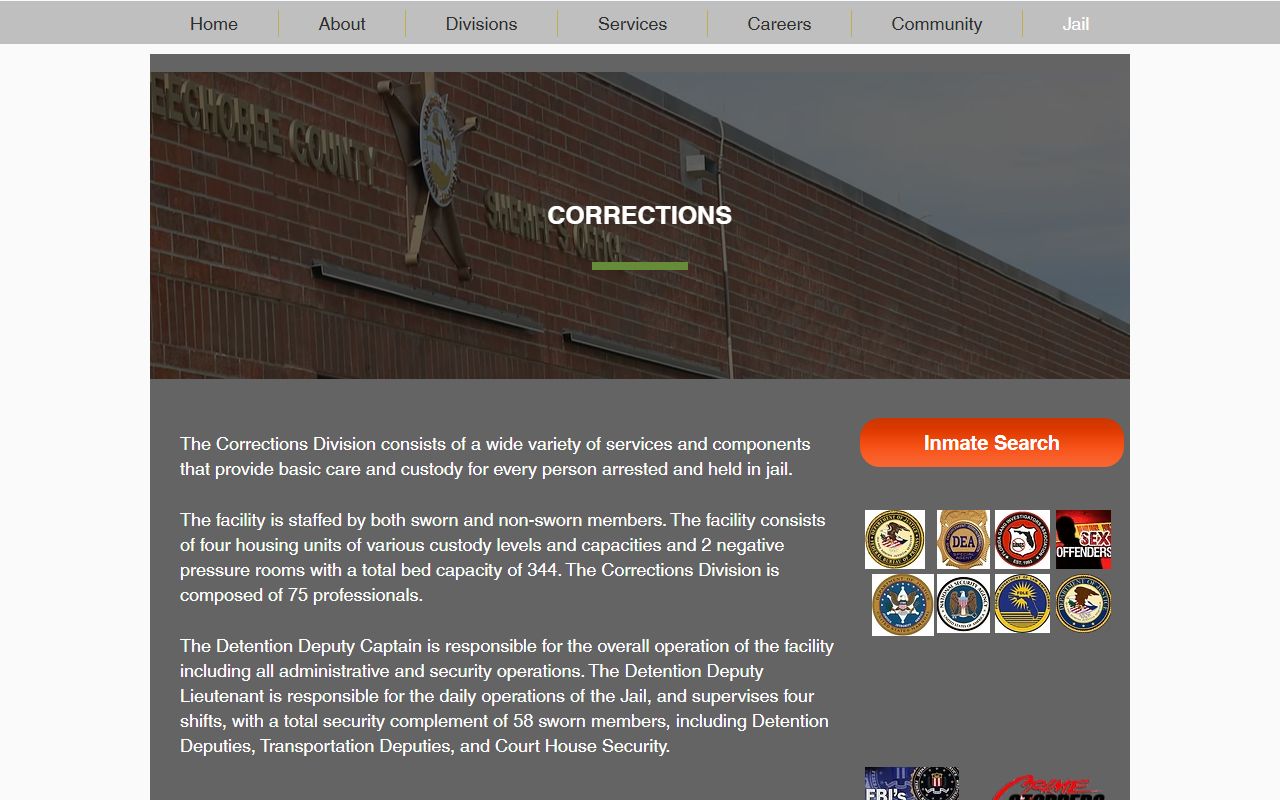
The same corrections page is the right starting point when a published number on this site does not match what you see, because the sheriff updates it directly. For a live custody question, the jail phone line is faster than any static page.
Okeechobee County Jail Capacity and Housing
Capacity is the part of the Okeechobee County inmate population that is well documented. The jail is rated for 344 beds and is divided into four housing units. Two of those are negative-pressure rooms, which let staff isolate someone with a medical or infection concern. About 75 corrections professionals run the facility. Those are not huge numbers, and that is the point. This is a medium-sized rural county jail, not a metro complex or a sprawling prison yard.
Capacity is not the same as a daily count. A jail rated for 344 beds does not mean 344 people are inside today. The sheriff has not published a current population, an average daily population, an annual booking total, or an average length of stay in the pages reviewed for this site. Rather than guess, those figures are listed as not published. A reader who needs a hard count should call the jail or file a public-records request.
Note: The two negative-pressure rooms are a real operational detail, not a general claim, and they show why a jail tracks medical housing separately from its general units.
Where Okeechobee County Population Numbers Come From
Because the sheriff does not post a daily or multi-year jail count, the best way to study the Okeechobee County inmate population over time is to use the agencies that collect jail data on a national or statewide basis. None of these replaces the sheriff for a live custody question, but each one helps put the local count in context, and each is free to search.
| Source | What It Provides | Where |
|---|---|---|
| BJS Annual Survey of Jails | National jail population context and methodology | bjs.ojp.gov |
| Vera Incarceration Trends | County-level incarceration trends over time | trends.vera.org |
| Jail Data Initiative | Roster-derived jail counts where available | jaildatainitiative.org |
| U.S. Census QuickFacts | County resident population and demographics | census.gov |
For an official local figure, the county budget process and a public-records request to the Sheriff's Office are the direct routes. The jail standards framework also produces inspection records that can be requested. The point is simple. Solid numbers exist, but the sheriff's website is not where the multi-year ones live.
Laws Governing the Okeechobee County Inmate Population
Florida treats jail and inmate information as public unless a specific exemption applies, and a handful of statutes set the frame. They explain why a roster can exist at all, why some fields are blanked out, and how the jail itself is held to a standard. Each one below is short to summarize, and each links to the official text.
Key Statutes:
Florida Statutes § 119.01 - sets the state policy that public records, including most jail records, are open for inspection and copying.
Florida Statutes § 119.071 - lists the exemptions that let an agency redact items such as some criminal-justice and personal information.
Florida Statutes § 951.23 - covers county and municipal jail standards and inspections under the Florida Model Jail Standards.
Florida Administrative Code Chapter 33-8 - carries the administrative rules tied to jail standards and detention oversight.
Two takeaways follow from this set. First, an agency that holds jail data has a legal duty to release the non-exempt parts, though it may charge a lawful copy fee. Second, exemptions are real, so a denied or redacted record is not always an error. The jail standards rules matter for the population side too, because they govern how a county jail must be run and inspected.
Okeechobee County and the Florida Prison Population
A large share of the people the public calls Okeechobee inmates are not in the county jail at all. They are in state prison. After a felony conviction and a sentence to the Florida Department of Corrections, a person leaves the county jail, passes through reception and classification, and joins the statewide prison count. At that point the county roster usually drops them, and the FDC locator becomes the correct path.
Okeechobee County is unusual because a state prison sits inside its borders. Okeechobee Correctional Institution is an adult male facility with a capacity of 1,632, far larger than the 344-bed county jail. The FDC lists two satellite units tied to it, the Okeechobee Work Camp and the Sago Palm Re-Entry Center. Sago Palm is physically in Palm Beach County, so it counts as a satellite rather than an Okeechobee building. The Okeechobee Correctional Institution facility page carries the prison's own details.
How to Search the Okeechobee County Inmate Population
Searching starts with one decision. Is the person newly arrested and likely in the county jail, or already sentenced and likely in state prison? The county jail roster and the state locator are separate tools, and using the wrong one is the most common reason a search comes back empty. For a current local booking, the sheriff's inmate search page is the official county channel.
Before you start, have the person's full name ready, and a booking number if you have one. A date of birth helps when a name is common. Then work the steps in order.
- Open the sheriff's inmate search page and let the embedded roster load.
- Enter the person's last name, then add the first name to narrow a common match.
- If the roster offers a booking number field, use it to jump straight to one record.
- Open the profile to read the listed charges, bond, and housing status.
- If the person was sentenced to prison, switch to the Florida DOC locator instead of the county roster.
When the roster does not show the person, do not assume they were never booked. New arrivals, transfers, releases, and held records can lag or stay off a public roster. The jail phone line at 863-763-3117 is the practical fallback for a live answer.
Current Inmate Lookup in Okeechobee County
The sheriff's inmate search is the live channel for people in county custody right now. The page is the official route and sits inside the corrections section of the sheriff's site. Its search runs inside an embedded component, so the exact field labels appear once the page loads in a browser rather than in the page's static code. Treat the live page as the authority on which fields it accepts, and do not rely on third-party jail sites that copy and resell roster data.
A current-inmate result is a snapshot. It reflects custody at the moment the roster refreshed, not necessarily this minute. If a bond was just posted or a transfer just happened, the public view can trail the real status by a short window. That is normal, and the fix is a phone call rather than a refresh.
Note: A person who appears one hour and not the next has usually been released, transferred, or moved to a status the public roster does not display.
What an Okeechobee County Inmate Record Shows
A county booking record generally carries the same core fields from jail to jail, even when a given roster chooses to hide some of them. The list below describes the fields a Florida booking record typically holds, drawn from the standard intake process rather than from any one profile. Confirm the exact display on the live sheriff page, since the public view can show fewer fields than the internal record.
| Field | What It Shows |
|---|---|
| Booking Number | The unique number the jail assigns to one booking event. |
| Booking Date and Time | When the person was processed into county custody. |
| Charges | The arrest or booking charges, which can differ from the charges a prosecutor later files. |
| Bond Amount | The amount or type of bond set, or a no-bond status. |
| Housing Unit | The unit or status assigned after classification. |
| Custody Status | Whether the person is held, released, or pending a hold or transfer. |
It helps to know a few terms before reading a profile, because the labels are not always plain. The short glossary below covers the ones that confuse people most.
- Pretrial detainee
- A person held before a case is resolved, not yet convicted.
- No-bond hold
- A status where ordinary bond will not release the person until a court acts.
- Detainer
- A notice from another agency asking the jail to hold or notify before release.
- Classification
- The jail's assessment that decides housing and security level.
- First appearance
- The prompt court review after arrest, generally within 24 hours under Florida Rule 3.130.
County Jail vs. State Prison: Where to Look
The single biggest mistake in an Okeechobee inmate search is looking in the wrong system. The county jail holds pretrial detainees and short county sentences. The state prison holds sentenced felons. Each has its own locator, and a person crosses from one to the other only after conviction and sentencing. The table makes the split plain.
| County Jail | State Prison (FDC) | |
|---|---|---|
| Who Is Held | Pretrial and short sentences | Sentenced felons |
| Run By | Okeechobee County Sheriff | Florida Department of Corrections |
| Where to Look | Sheriff inmate search | FDC inmate population search |
| Stays Listed | While in county custody | Through the state sentence; release dates update nightly |
Past and released inmates follow the same logic. A county roster shows current custody, so a released person usually drops off it, and an archived booking may take a public-records request to the sheriff. A person who finished a prison term can still appear in the state system, since the FDC database keeps public-record information on offenders sentenced to the department since 1983.
State and Federal Inmate Search
Once a search moves past the county jail, three more systems come into play. The Florida Department of Corrections runs the Inmate Population Information Search for sentenced state prisoners. The Federal Bureau of Prisons runs the federal inmate locator, and Immigration and Customs Enforcement runs the Online Detainee Locator System. For custody alerts, VINELink Florida sends notifications. The FDC search form is well documented, and its fields are shown below.
| Field Label | Type | Required | Notes |
|---|---|---|---|
| Last Name | Text | No | Max 30 characters; matches names that begin with the letters typed. |
| First Name | Text | No | Max 15 characters; prefix-style match. |
| DC Number | Text | No | Six characters, all numeric or one letter plus five numbers. |
| Search aliases | Checkbox | No | Checked by default; also searches alias names. |
| Matches per page | Dropdown | No | 10, 15, 20, 25, 30, 35, 40, 45, or 50. |
The FDC notes that its population data is refreshed weekly, while release dates and location changes update nightly. It also states plainly that the database does not include people sentenced to county jail or county probation, which is exactly why the county roster and the state locator stay separate.
The state search form looks like the screenshot below, which helps when you reach the live page: the FDC Inmate Population Information Search is the form to use for a sentenced state prisoner.
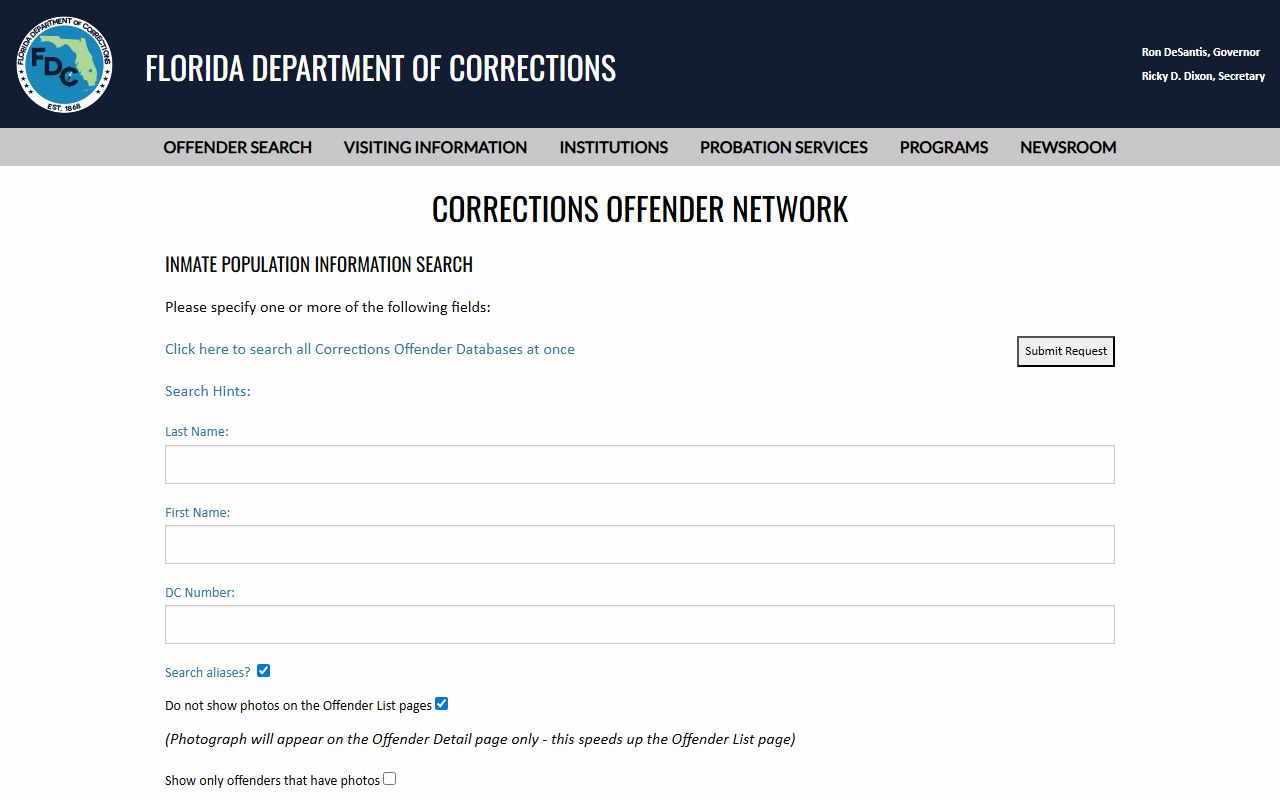
Seeing the form first saves a step, because the county roster and this state form ask for different things. A federal or immigration question moves to the BOP or ICE locators instead, and neither of those publishes a county booking photo.
Okeechobee County Detention Facilities
Two facilities hold the Okeechobee County inmate population, and they serve opposite ends of the custody timeline. The county jail is the front door after an arrest. The state prison is where long sentences are served. Each has its own page on this site with contact details and a lookup walkthrough.
- Okeechobee County Jail - the 344-bed sheriff's jail for new arrests, pretrial detainees, and short county sentences.
- Okeechobee Correctional Institution - the Florida DOC adult male state prison north of town for sentenced inmates.
For booking photos and roster detail, the jail inmate records page goes deeper on the county side. The charges that follow an arrest live on the court side rather than the roster.
Okeechobee County Inmate Population FAQ
How big is the Okeechobee County inmate population?
The county jail is rated for 344 beds, and the state prison in the county has a capacity of 1,632, both from official pages. The sheriff does not post a live daily jail count, so a current average daily population is not published. For a hard number, call the jail or file a public-records request, and use BJS, Vera, or the Jail Data Initiative for trend context.
How do I search the Okeechobee County inmate population?
Start with the sheriff's inmate search for anyone in county custody. If the person was sentenced to state prison, use the Florida DOC Inmate Population Information Search instead. For federal or immigration custody, use the BOP or ICE locators. When a roster does not show someone you expect, call the jail at 863-763-3117 to confirm.
Can I look up a released or past inmate?
A county roster shows current custody, so a released person usually drops off it, and an older booking record may take a public-records request to the sheriff. The Florida DOC database, by contrast, keeps public-record information on people sentenced to the department since 1983, so a past state prisoner can still appear there.