
Okeechobee County Court Records After a Jail Arrest
After an arrest in Okeechobee County, the person is booked into the jail, brought to a first appearance, and then waits while the prosecutor decides what to file. The State Attorney for the 19th Judicial Circuit, not the jail, makes that charging decision. When the prosecutor files, a case opens in court and the court record begins. From that point the court record, rather than the booking sheet, is the authority on the charges and how the case moves.
It is worth keeping the booking side and the court side separate in your mind. For the roster, the booking, and custody status, the jail inmate records page covers the sheriff's system, and booking photos sit on the jail roster mugshots page. The court record is a different file. It holds the charges the prosecutor actually filed after the arrest, the hearing dates, and the disposition, and it is searched through the clerk rather than the sheriff.
How to Find Okeechobee County Court Records After an Arrest
The Okeechobee County Clerk and Comptroller keeps the court case records, and the case search is where filed charges and their status appear. The clerk's records search page and the Florida OCRS Okeechobee County entry are the official routes. Booking detail still lives on the jail roster, so use the court tools for the case itself.
- Open the clerk's records search or the OCRS county court search.
- Search by the defendant's name, or by case number if you already have one.
- Open the case and read the list of charges the prosecutor filed.
- Check each charge's code, level, and current status, then note the hearing dates.
The OCRS county entry leads into the statewide court search interface used by participating Florida clerks. The screenshot below shows that Okeechobee County OCRS entry page where a court search begins.
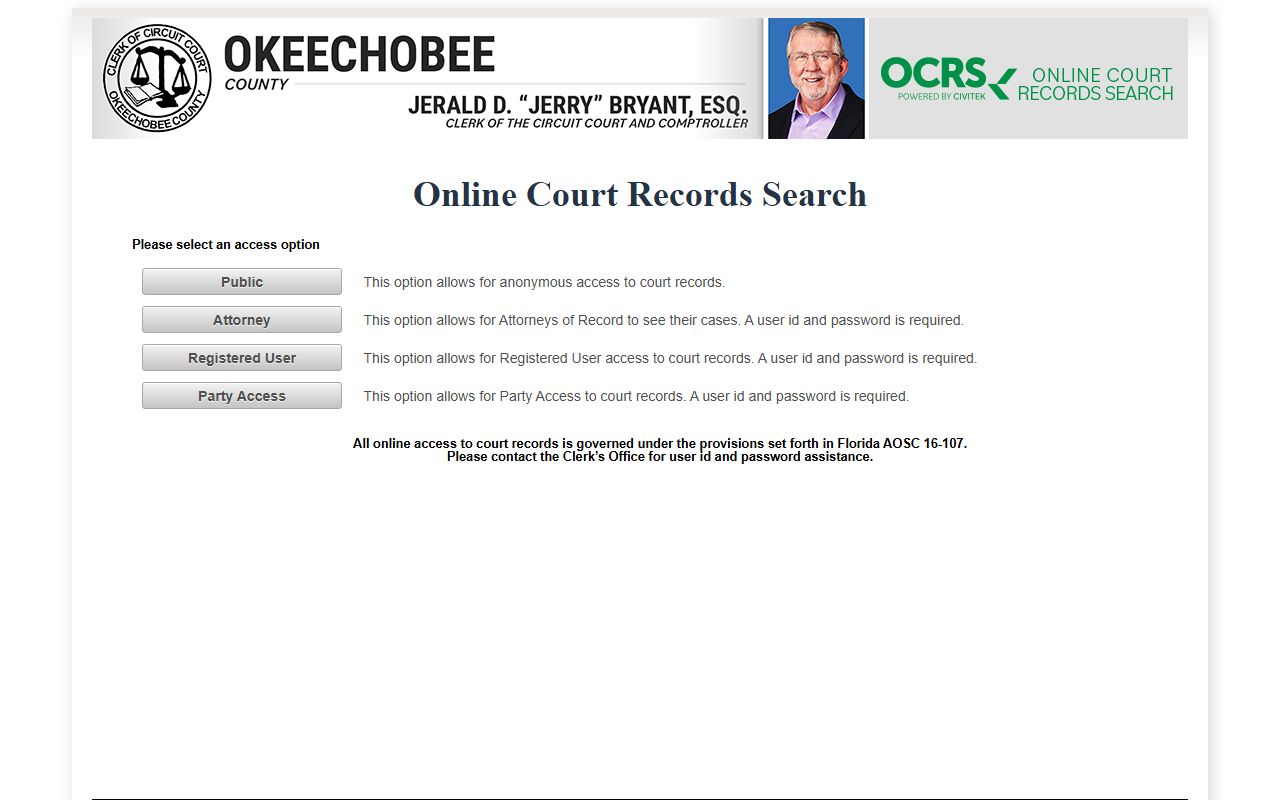
The clerk also runs a Landmark Web portal for official records and documents, which is useful for filed papers though it is not the jail roster. When you have a case number from the roster or a hearing notice, use it to go straight to the case rather than wading through name matches. Comparing the booking charges on the roster against the filed charges in the court file is the fastest way to see what the prosecutor actually did with the case.
For records that are older, sealed, or not online, the clerk handles them directly through its records process. A statewide criminal-history check is a separate request through the Florida Department of Law Enforcement, with its own fees and rules, and it is not something a jail roster can answer.
How Charges Get Filed After an Arrest: Complaint, Information, and Indictment
The arrest does not set the charges in stone. After booking, the charge record begins in earnest when the prosecutor files a charging document, and the type depends on the offense. In Florida, most felonies are charged by an information filed by the State Attorney, while the most serious cases can go to a grand jury for an indictment. The table sorts out the three.
| Complaint | Information | Indictment | |
|---|---|---|---|
| Filed By | Officer / Prosecutor | State Attorney | Grand Jury |
| Common For | Misdemeanors | Many felonies | Serious felonies |
| Starts | The case | The case | The case |
The State Attorney for the 19th Judicial Circuit serves Indian River, Martin, Okeechobee, and St. Lucie counties, and its office decides whether to file, decline, amend, or reduce charges. The screenshot below shows the State Attorney 19th Judicial Circuit homepage, the office that handles those charging decisions for Okeechobee County.
Because the prosecutor controls the filing, the booking charge and the filed charge are not always the same. That gap is the single most useful thing to understand when reading a court record after an arrest.
Charge Status and What It Means
Charges change as a case moves. A prosecutor can amend, reduce, add, or drop a charge, and a judge can dismiss one. Because of that, the charges on the jail roster at booking can read differently from the charges in the court file weeks later. The terms below are the ones that appear most often on a docket.
| Status | What It Means |
|---|---|
| Pending | The charge is open and not yet resolved. |
| Amended / Reduced | The charge was changed or lowered to a lesser offense. |
| Dismissed | The court or prosecutor ended the charge. |
| Nolle Prosequi | The prosecutor chose not to proceed on the charge. |
Note: A disposition such as dismissed or nolle prosequi is not the same as an erased record, and clearing the public record may still take a separate sealing or expunction step.
Bond and Release After an Arrest
Bond is usually set or reviewed at first appearance, the prompt hearing Florida requires after an arrest. The judge weighs the charge and the statutory bail criteria, then sets a release condition. Florida Statutes section 903.046 lists the criteria for setting bail, and section 907.041 governs pretrial detention and release. A booking charge is not the last word on release, because a court order or a separate hold can keep a person in custody no matter the bond.
| Bond Type | How It Works |
|---|---|
| Cash Bond | The full amount is paid in cash or certified funds through the court or jail process. |
| Surety Bond | A licensed bail bond agent guarantees appearance for a fee. |
| PR / Own Recognizance | Release on a written promise to appear, with no cash posted, but conditions still apply. |
| No-Bond Hold | Ordinary bond will not release the person until a court acts or the hold clears. |
Holds complicate release. An out-of-county warrant, a probation hold, or an immigration detainer can keep someone in jail even after a bond is posted on the local charge. Before posting bond, it is worth confirming with the jail whether any hold applies.
Warrants That Lead to an Arrest
Many arrests start with a warrant. A judge can issue an arrest warrant on probable cause or a bench warrant for a missed court date, and either one can put a person in the county jail once served. Okeechobee County does not publish a clear public warrant database in the sheriff pages reviewed, so warrant status is best confirmed through the issuing court or the clerk's case file. A bench warrant or failure-to-appear warrant is usually tied to an existing court case, which makes the clerk's records the place to look.
A website cannot clear a warrant. The safe route is to contact the issuing court or an attorney to confirm the warrant and the surrender or bond instructions. Once a person is arrested on a warrant and booked, the custody may show on the sheriff's roster, while the court file shows the underlying case and the warrant event.
Charges vs. Convictions
An arrest and a charge are accusations, not proof of guilt. A conviction comes only after a plea or a verdict. Both can appear in public records, but they sit at different stages and carry a different weight, which the table makes clear.
| Charge | Conviction | |
|---|---|---|
| Stage | Accusation | Verdict or plea |
| Burden of Proof | Probable cause | Beyond a reasonable doubt |
| Public Record | Yes | Yes |
Treating a charge as a conviction is a common and serious mistake. A case can end in dismissal, acquittal, or a reduced plea, and the court record is where the real outcome is recorded.
Sealed vs. Expunged Arrest Records
Florida lets eligible people clear a record after an arrest. Section 943.059 covers court-ordered sealing, which restricts public access, and section 943.0585 covers expunction, which goes further toward removal. Both require a court order and an eligibility check, and neither is automatic after a dismissal.
| Sealed | Expunged | |
|---|---|---|
| Visibility | Hidden from public view | Destroyed or treated as never existed |
| Law Enforcement | Limited access | Very limited access |
| Eligibility | Set by Florida Statutes § 943.059 | Set by Florida Statutes § 943.0585 |
Because eligibility turns on the charge, the disposition, and a person's history, the clerk and an attorney are the right sources for whether a specific record qualifies.
Background Check Considerations
A casual court-record lookup is not the same as a regulated background check. Formal screening for jobs, housing, or credit must follow the Fair Credit Reporting Act and use a proper consumer reporting agency. The court search tools and any search box on this site are for general public reference, not for those regulated decisions.
Important: This is not a consumer reporting agency under the FCRA, and nothing here may be used for employment, housing, credit, or insurance screening.
Restricted Court Records After an Arrest in Okeechobee County
Not every court record after an arrest is open. Juvenile cases, sealed and expunged records, and some dismissed charges can be withheld or restricted, and records tied to an ongoing investigation may be exempt under Florida's public-records exemptions. When the online case search comes up empty for a record you expect, a restriction or an exemption is a common reason, not always an error.
Juvenile cases deserve special care, since Florida shields most juvenile records from open public search, and a dismissed charge can sometimes be withheld from the public index even before any sealing order. Those rules protect people, but they also mean the absence of an online result does not prove a person was never arrested or charged.
For a restricted or missing record, the clerk can explain what is available and how to request it. Florida Statutes section 119.071 lists the exemptions that allow an agency to withhold or redact certain information, which is why a record can exist yet stay out of the public view.